
Well & Water Systems: How Water Gets From the Ground to Your Tap
For many homeowners in Renfrew County, turning on the kitchen tap means relying on your own private well. There is no municipal watermain running past the house and no water tower supplying pressure. Instead, your property has its own small water system that has to find groundwater, bring it to the surface, and maintain enough pressure to supply everything from the shower to the washing machine.
The system is actually fairly simple. A drilled well accesses groundwater below the property, a submersible pump pushes that water into the house, and a pressure tank and pressure switch control when the pump operates.
How Is a Well Drilled?
Before construction starts on a new rural home, the well location is established on the site plan. Once the driveway and building site are accessible, the well drilling contractor can bring in the specialized drilling rig. This is one of the early infrastructure steps when building outside serviced areas.
There are two basic ways to make the hole for a drilled well: rotation and percussion.
Rotary drilling uses a spinning drill bit to cut, scrape, and grind its way through the ground. Different bits can be used depending on whether the driller is working through clay, sand, gravel, or rock. Air, water, or drilling fluid is circulated through the hole to carry the cut material back to the surface.
Percussion drilling works differently. Instead of relying mainly on rotation, the drill breaks material by repeatedly striking it. Older cable-tool rigs did this by lifting and dropping a heavy drill bit into the hole over and over again. This is the traditional method people often mean when they describe a well as being “pounded.”
Modern bedrock drilling often combines both methods. A down-the-hole hammer is mounted directly behind the drill bit. Compressed air makes the bit strike the rock rapidly while the entire drill string also rotates. The pounding action breaks the rock, the rotation keeps the hole even, and compressed air carries the broken rock back to the surface.
If you have ever watched a well being drilled in Renfrew County and seen a rig making a tremendous amount of noise while rock chips, dust and water blow out of the top of the casing, this is likely what you were watching.
Steel casing is installed through loose soil and fractured material near the surface. This keeps the well from collapsing and helps prevent surface water from entering it. Once competent bedrock is reached, drilling can continue deeper into the rock.
The well contractor keeps drilling until an adequate water supply is found. One property may encounter good water relatively quickly, while another may require considerably more depth. The geology below the property controls the result, which is why the final depth of a well can be difficult to predict beforehand.
Getting the Water Into the House
Finding water is only the first step. Now we need to get it from the bottom of the well to your kitchen.
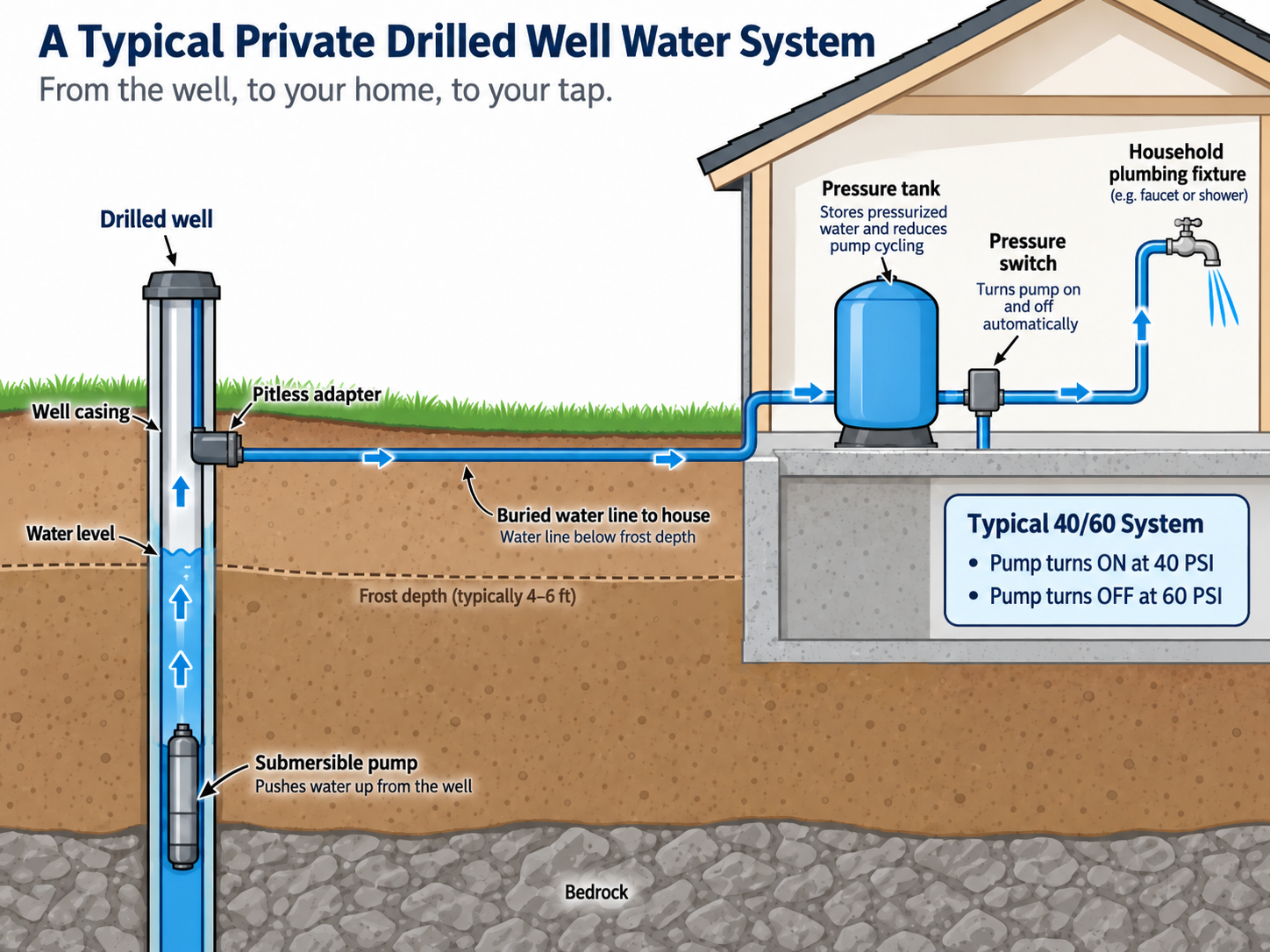
Most modern drilled wells use a submersible pump. As the name suggests, the pump operates completely underwater, usually well below the normal water level in the well.
The pump is a long cylindrical electric unit connected to a water pipe and electrical cable. When electricity is supplied to the pump, a series of impellers inside it creates pressure and pushes water up the pipe. That distinction is important. The pump is not sitting in the basement trying to suck water hundreds of feet out of the ground. It is down inside the well pushing the water toward the house.
Near the top of the well, the water line exits through a fitting called a pitless adapter. This allows the pipe to leave the side of the well casing below frost depth and travel underground to the house. In our Eastern Ontario winters, keeping that water line safely below the frost zone is obviously important.
What Does the Pressure Tank Do?
Once the water reaches the house, it normally enters a pressure tank. A pressure tank contains both water and compressed air, usually separated by a flexible bladder or diaphragm. As the well pump pushes water into the tank, the water compresses the trapped air. That compressed air is what provides pressure when you open a faucet.
Without a pressure tank, the well pump would need to start every time somebody wanted a glass of water or flushed a toilet. Pumps do not like constantly starting and stopping. The pressure tank stores a usable amount of pressurized water and greatly reduces the number of times the pump has to cycle. The result is steadier water pressure and a longer pump life.
What Does 40/60 Pressure Mean?
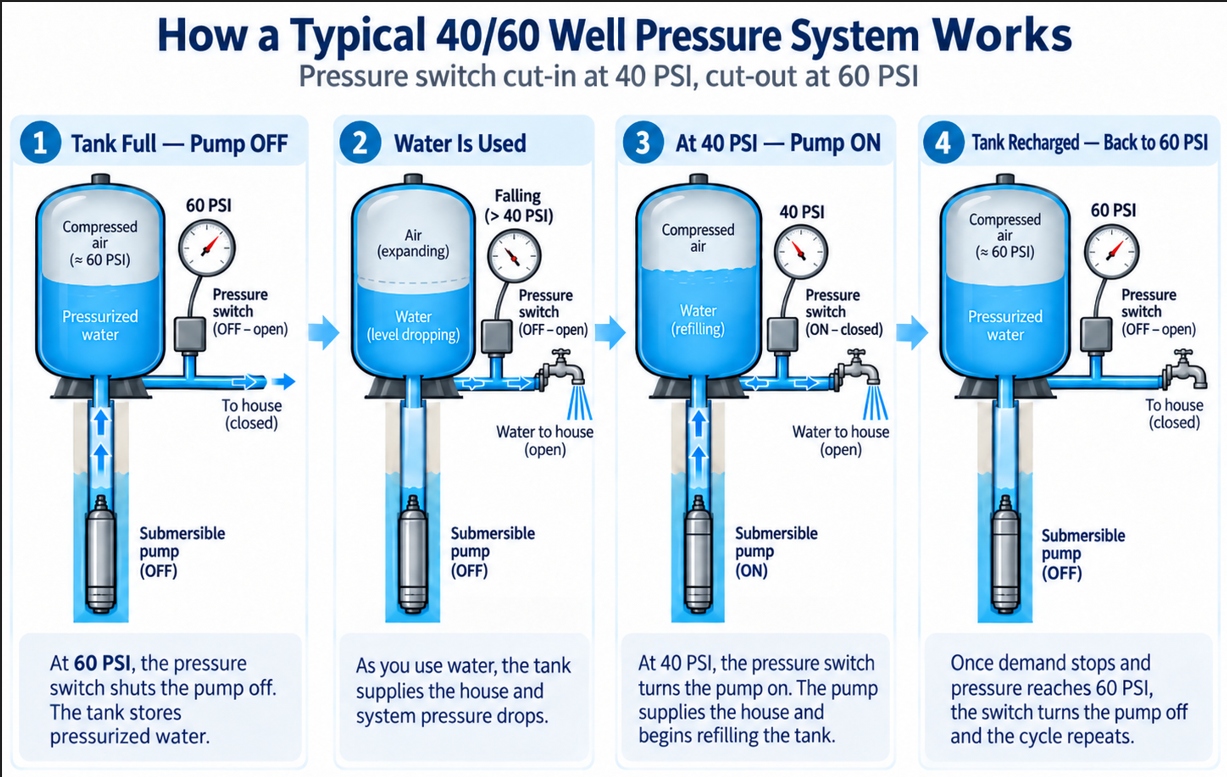
A very common residential well system operates at 40/60 PSI. There is a pressure switch installed on the system that monitors the water pressure. When you open a tap, water leaves the pressure tank and the pressure gradually drops. When it reaches approximately 40 PSI, the pressure switch turns the well pump on. The pump begins pushing water into the system. If you are still using water, the pump supplies that demand while rebuilding pressure in the tank.
Once the pressure reaches approximately 60 PSI, the pressure switch shuts the pump off. You then use the stored water until the pressure falls back to 40 PSI, and the cycle starts again. You may notice a slight difference in shower pressure between the high and low ends of that range, but in a properly designed system it should not be dramatic.
A Simple System Doing an Important Job
A private well system has relatively few components, but every one of them has an important job. The drilled well provides access to groundwater. The submersible pump moves that water into the house. The pressure tank stores water and prevents unnecessary pump cycling, while the pressure switch automatically keeps the system operating within its designed pressure range.
When everything is sized and installed correctly, you don't have to think about any of it. You simply turn on the tap and water comes out — which is exactly how a good building system should work.
September 14th, 2026