Making Decisions Efficiently: What Science and Experience Can Teach Us
Every day we’re faced with decisions, from the small and routine to the ones that carry long-term consequences. Some choices come easily — what to eat for lunch or which sweater to put on in the morning. Others, like choosing a contractor, deciding on a renovation, or planning a new home build, carry more weight. The challenge isn’t just making decisions but making them efficiently. Waiting too long can mean missed opportunities, while rushing can lead to mistakes. Both scientific studies and everyday experience show us how to strike the right balance — and it’s the same balance we help our clients find at Quality Homes & Renovations.
The Science of Decision-Making
Researchers have studied decision-making for decades, and one consistent theme is that the human brain has limited energy for careful choices. Psychologist Roy Baumeister’s work on “decision fatigue” demonstrated that the more decisions people made, the more their ability to weigh options declined. In one study, judges were more likely to grant parole early in the morning or after a meal than at the end of a long session. As fatigue set in, they defaulted to the easiest option — usually denying parole altogether.
The lesson here is clear: timing matters. When your mind is fresh, you’re better able to evaluate trade-offs. Later in the day, efficiency drops. For big choices it helps to tackle them earlier in the day or after a break.
Behavioral economists Daniel Kahneman and Amos Tversky also showed that we rely on shortcuts, or heuristics, when making decisions. They aren’t always perfect, but they save time. For instance, if two flooring options look similar, many homeowners will choose the one they recognize or the one a trusted builder recommends. It’s efficient, and it usually works.

When Too Many Options Backfire
At the other end of the spectrum is “paralysis by analysis.” Too many choices can slow us down to the point where no decision gets made at all. A well-known grocery store study by Sheena Iyengar illustrated this perfectly: shoppers who were offered 24 varieties of jam were less likely to choose anything than those who saw just six. Too many choices overwhelmed them.
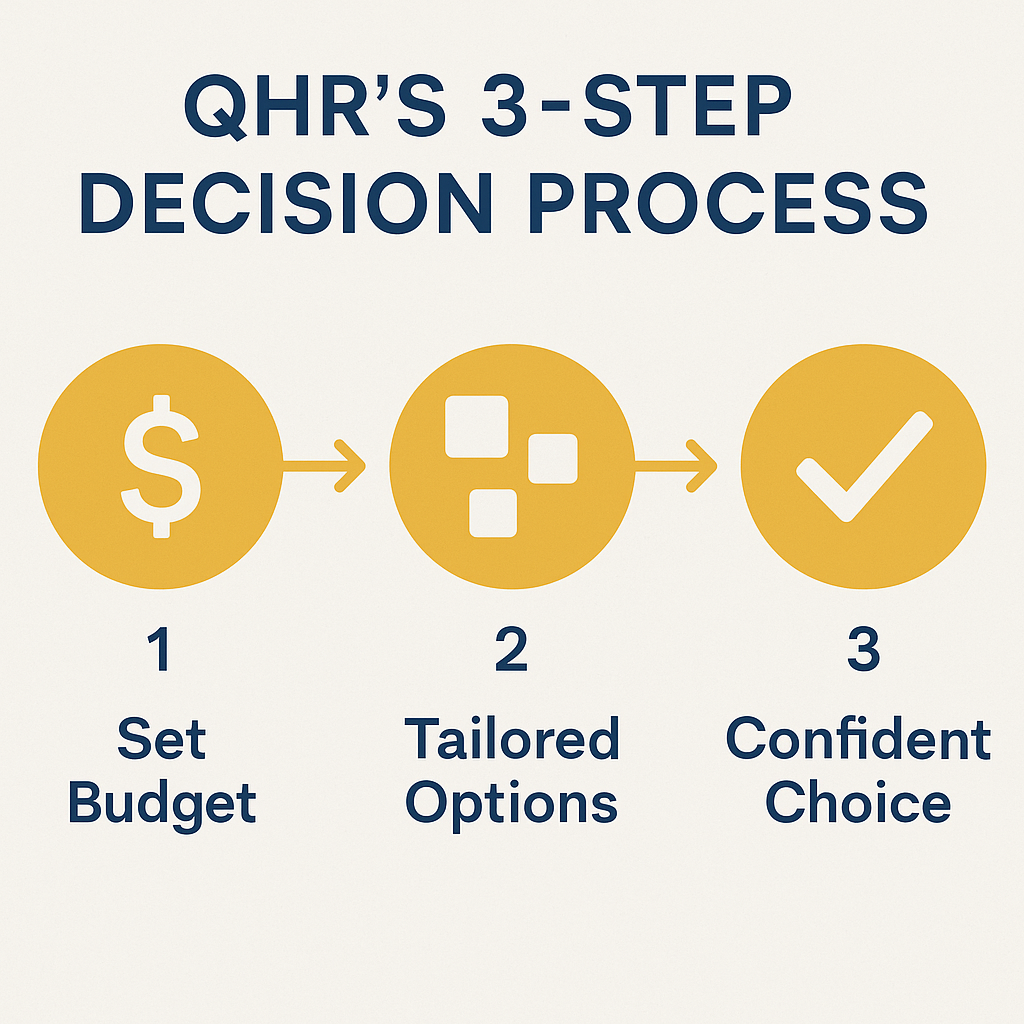
In construction and renovation, the same thing can happen. With endless cabinet finishes, flooring types, and paint colours available, it’s easy to get stuck. That’s why we at Quality Homes narrow options to those that fit the customer’s style, budget, and long-term goals. By cutting through the noise, decisions become easier and far less stressful.
Lessons From Real Experience
Scientific studies provide the theory, but real-world examples show how decisions get made in practice. Tradespeople don’t waste time reading spec sheets every time they choose a tool. They rely on experience, recommendations, and what has worked in the past. That mix of knowledge and practicality allows them to move quickly and focus on the work.
Homeowners do something similar every day. Parents, for instance, often make household choices by sticking to routines or rotating through a small number of options. That reduces conflict, saves time, and keeps life moving.
At Quality Homes & Renovations, we see this in action whenever we help customers choose the finishes for their home. Some come in with a strong vision, while others need guidance. Either way, our job is to offer options that fit the budget and help them move forward without spinning their wheels.
Strategies for Efficient Decisions
Blending science with experience, a few key strategies stand out. First, make important choices when your energy is highest. Second, narrow the field — you don’t need twenty countertop samples to find one that works. Third, lean on trusted advice and past experience. And finally, accept that decisions don’t need to be perfect. Often, the right choice is the one that lets you keep moving forward with confidence.
By presenting tailored options that match a customer’s budget, we make sure the decision-making process is efficient rather than overwhelming. Clients don’t have to choose from every product on the market — just the ones that fit their project best.
Logic, Instinct, and Balance
Efficient decision-making also means trusting instincts when appropriate. Intuition isn’t guesswork; it’s often the product of experience and subtle signals your brain has picked up. For homeowners, this might mean feeling more comfortable with one layout over another, even if both are technically sound. Research supports this too — in some complex situations, intuitive judgments can be just as accurate as deliberate ones, and far faster.
Making decisions efficiently is about finding a balance between speed and care. Science shows us that too many options can overwhelm us, that timing matters, and that our brains work best in bursts. Everyday experience shows that routines, advice, and intuition all help us move forward without wasting time. At Quality Homes & Renovations, we build those lessons into how we work with clients. By providing excellent options tailored to their needs and budget, we simplify the process and help decisions happen smoothly. The result is a project that feels less overwhelming, moves forward on schedule, and delivers a home that works for the long term.

November 10th, 2025