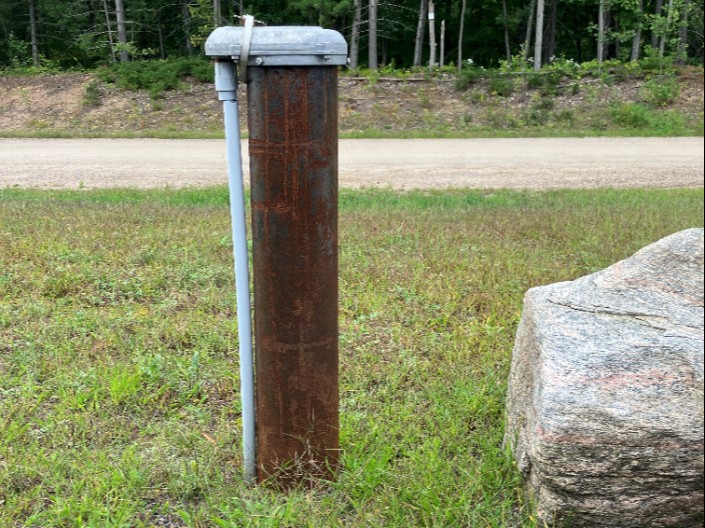
Well & Water Systems Part II: Water Testing, Sediment Filters & Water Softeners
In Part I, we followed the water from a drilled well through the submersible pump, pressure tank and into the plumbing system of the home. But getting water out of the ground is only half the story.
Groundwater is not manufactured to a standard. Two wells a few kilometres apart can produce water that looks, tastes and behaves completely differently. One may provide clear, relatively soft water requiring almost no treatment, while another may contain sediment, iron or enough dissolved minerals to leave white scale on every faucet in the house.
That is why the next step in a new well system is finding out exactly what is in the water and deciding whether it needs to be treated.
Water Testing
You cannot determine whether well water is safe simply by looking at it. Clear, cold water can still contain bacteria, while water with an unpleasant mineral taste may actually be bacteriologically safe.
For private wells in Ontario, bacterial testing is available free through Public Health Ontario. The standard test looks for E. coli and total coliform bacteria. E. coli can indicate contamination from human or animal waste, while total coliforms can indicate that surface water or other contamination is finding its way into the well.
For a new home, testing the well is an important part of putting the water system into service. Testing should not end there. Ontario recommends that private well owners test their water for bacteria at least three times per year, with additional testing after events such as flooding, major repairs to the well or unusual changes in the water.
The free bacterial test does not tell you everything about the water. If there are concerns about hardness, iron, manganese, sulphur, nitrates or other minerals and chemicals, additional testing can be completed by an accredited laboratory.
That more complete water test also helps determine what treatment equipment is actually required. There is little sense installing equipment to solve a problem you don't have.
Sediment Filters
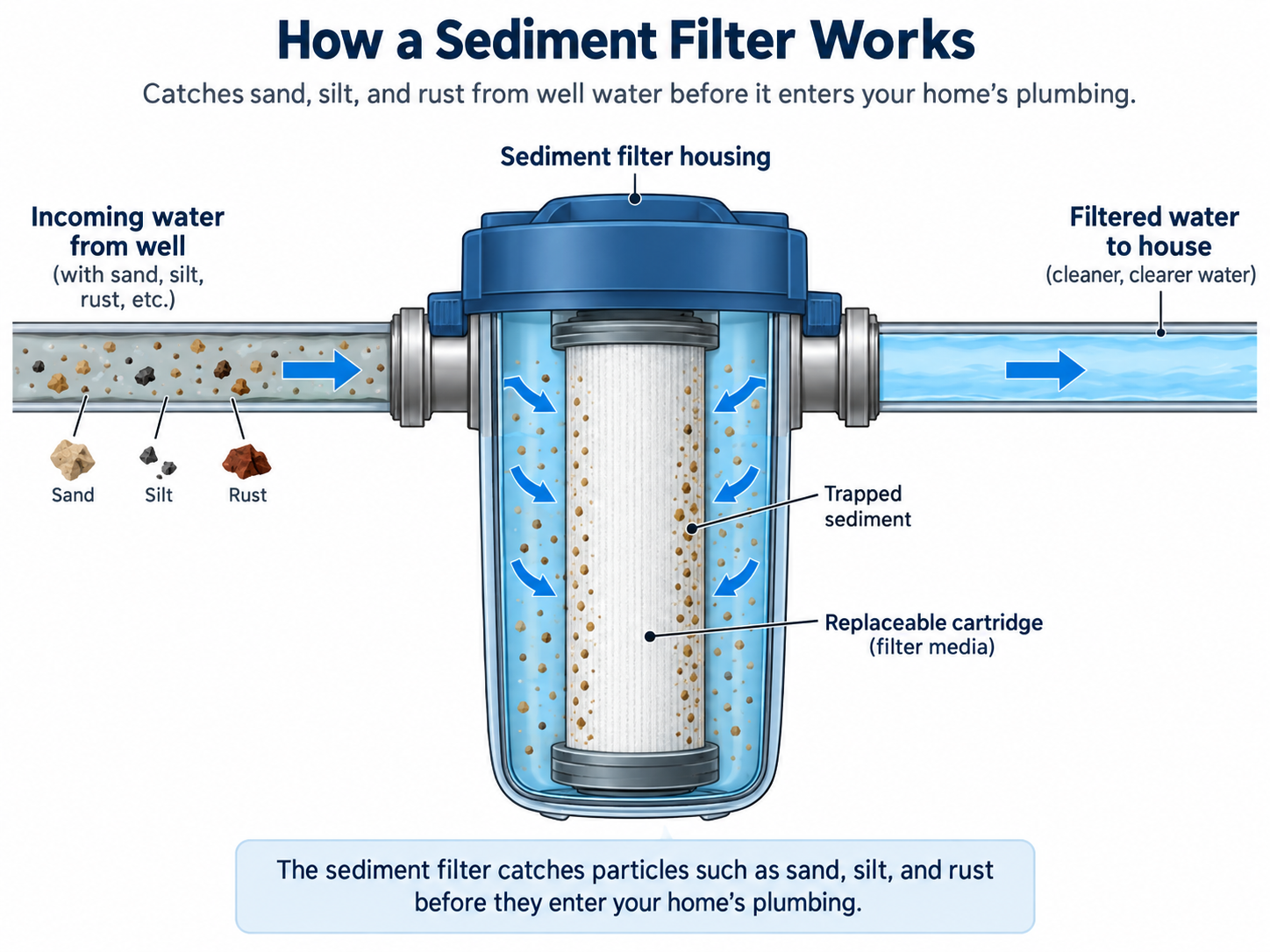
Many rural wells produce some amount of sediment. Fine sand, silt, rust or small mineral particles can travel into the home with the water.
A sediment filter is usually the first stage of water treatment. It is installed on the main water line after the pressure system so all the water entering the house passes through it. The simplest system uses a replaceable cartridge inside a filter housing. Water passes through the cartridge and the particles become trapped in the filter media. Different filters remove different particle sizes, measured in microns. A coarse filter can catch larger sand particles while a finer filter will remove much smaller material.
Some wells with heavier sediment loads may use a spin-down or washable pre-filter ahead of the finer cartridge. Instead of throwing the filter away every time it becomes dirty, accumulated material can be flushed from the bottom. Like almost everything in a home, sediment filters require maintenance. A clogged filter restricts water flow and can make it seem like the well system has poor pressure. If your normally strong shower suddenly becomes weak, checking the sediment filter is a good place to start.
What Is Hard Water?
Hard water is a different problem. You cannot remove hardness with a sediment filter because the minerals are dissolved in the water rather than floating around as particles.
Hardness is primarily caused by naturally occurring calcium and magnesium picked up as groundwater moves through rock and soil. It is not generally considered a health hazard, but it can certainly be a nuisance. Homeowners with hard water will recognize the signs. White scale develops around faucets and showerheads. Glass shower doors become spotted. Soap does not lather as easily. Kettles and coffee makers develop mineral deposits.
The bigger concern is what you cannot see. The same scale can form inside water heaters, plumbing fixtures and appliances. Over many years, that mineral buildup can reduce efficiency and shorten the lifespan of equipment.
How Does a Water Softener Work?
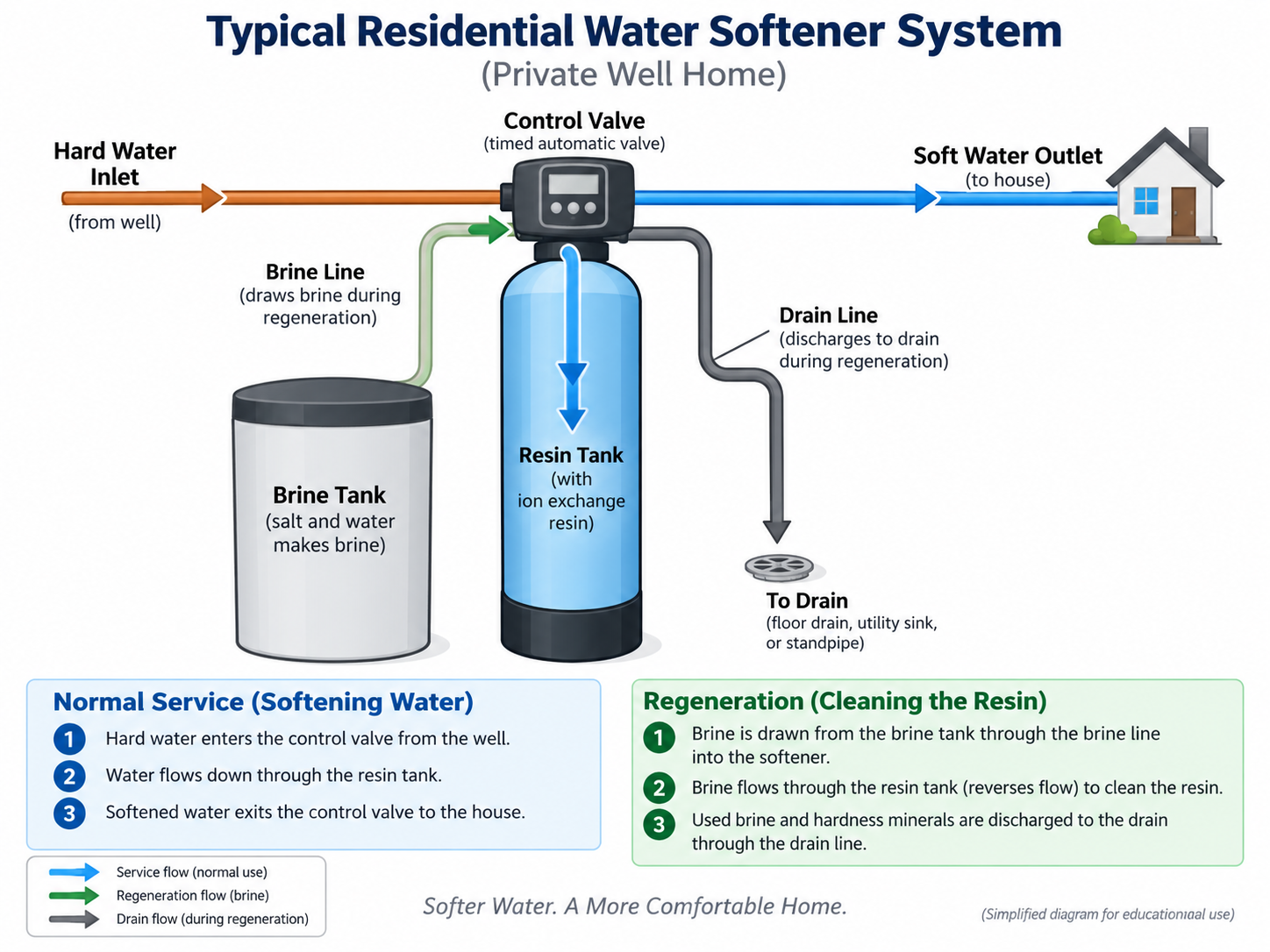
The usual solution is a water softener. Most residential softeners use a process called ion exchange. The water passes through a tank containing thousands of tiny resin beads. These beads attract calcium and magnesium ions and remove them from the water, exchanging them for sodium ions.
Eventually those resin beads become saturated with hardness minerals and need to be cleaned. The softener automatically enters a regeneration cycle and flushes a concentrated saltwater solution, called brine, through the resin. This removes the accumulated calcium and magnesium and prepares the softener to start treating water again. That is why a water softener has a second tank that homeowners periodically fill with bags of salt.
Treat the Water You Actually Have
There is no universal water treatment package that every rural home needs. Some wells require nothing beyond regular testing. Others benefit from a sediment filter. Areas with hard groundwater may need a softener, while iron, manganese, sulphur or bacterial problems can require different treatment equipment altogether.
The right approach is simple: drill the well, test the water, understand the results and treat the problems that are actually present. When the system is properly selected and maintained, your private well can provide clean, reliable water for decades — without giving much thought to what is happening between the bottom of the well and the kitchen tap.
September 28th, 2026